This website is speech enabled. Click on the blue icon, bottom right, to access. The website can be optimised for those with dyslexia.

News from The Australian Bonsai Gallery

First Flush Cut for Japanese Red & Black Pines

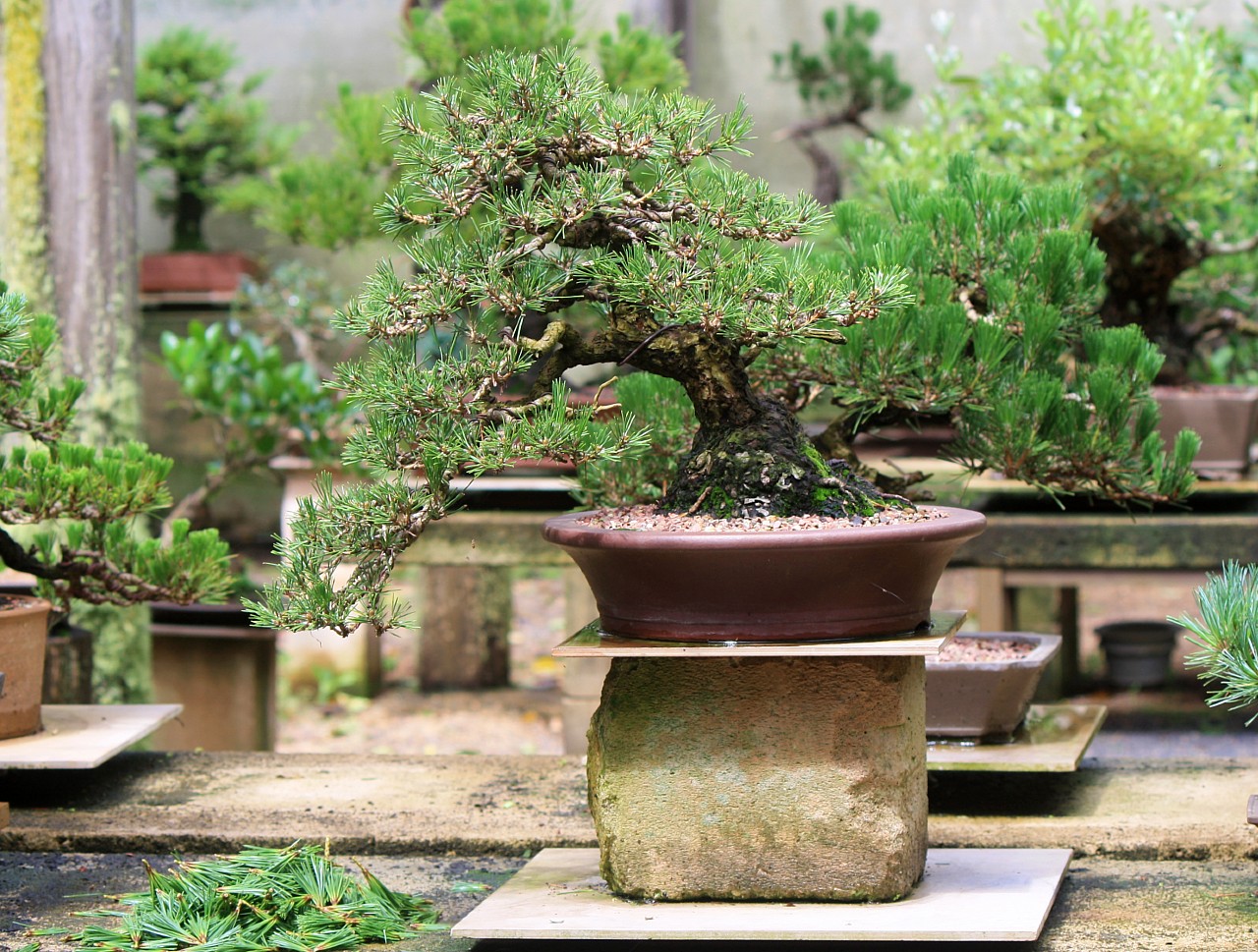
It is always a bit of 'hit-and-miss' as to when is the optimum timing for this process.  The Japanese Black Pine in this image has just been cut. As you can see from the pile of cuttings this is a significant event for these trees.

Vigure balancing last Autumn, continued fertilizing throughout Autumn and Winter, and booster fertilising in Spring and early Summer has produced a good and even first flush.  Now we wait for that all-important second flush to produce multiple shoots from all cutting points.!

It is very important to only cut unwanted shoots(bud selection) after the seconf flush has matured.... a job I do along with needle plucking and wiring in Autumn.  Then the process starts all over again.!

Last years effort was a real success, as is evedent in the very small one-year-old needles.  Another few years of the same will produce very well refined bonsai.

Fingers crossed that the warm weather holds for the next few months..... 

For those not familar with the process I have a detailed slideshow and downloadable pdf HERE
japanese black pine first flush cut

Trident Maple Major Branch Removed

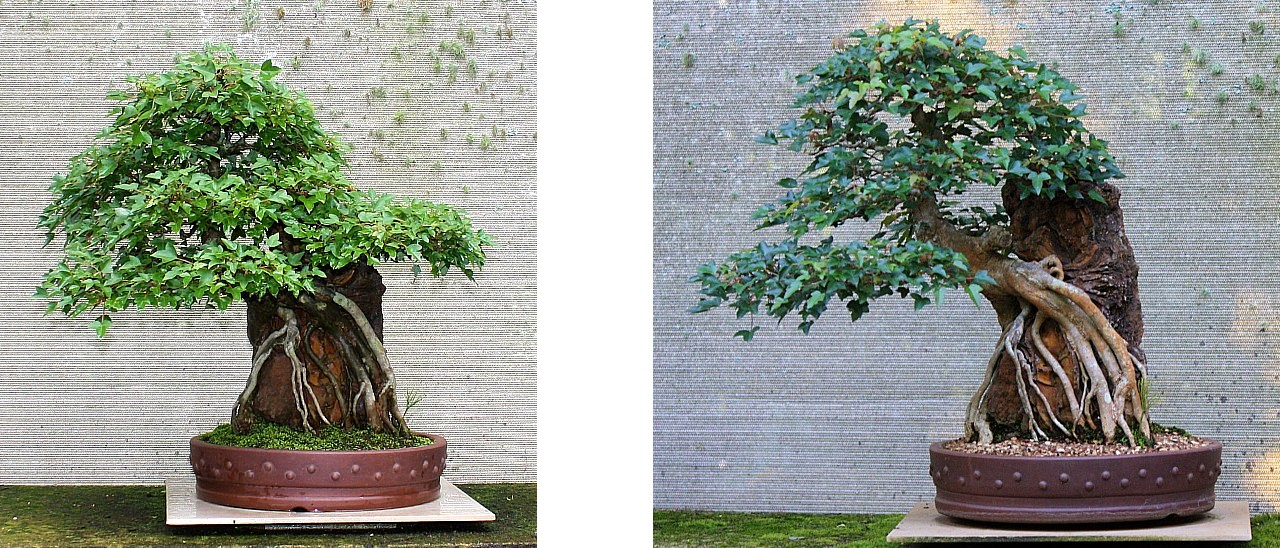
I felt that this root-over-rock Trident Maple lacked movement and did not feature the rock and the trunk dynamics enough so I made the decision to remove the large RHS branch.

To me this is a major improvement in the overall quality of this bonsai.  The movement in the trunk, and in the overall style, has created more drama and has highlighted the best features of the design.

Bonsai is all about recognizing the best features of your bonsai, building on these features, and going about showing them at their best.

With the 'Root-over-Rock' style it is essential to allow the tree to grow into the style and scale of the rock.  I have seen far to many trees 'out-grow' the rock, making the composition look completely out of scale.

This, and all others in the gallery collection, have been grown from cuttings.  One year old cuttings have been selected for their long roots and placed around 2/3rds the way up the rock, and allowed to grow into the scale of the rock.

Personally, I have an aversion to planting bonsai on the top of a rock.  In old Chinese landscape paintings you see trees growing on the tops of mountains BUT notice the scale.... the 'rock' is a mountain and the trees are small.... and to scale.  Many bonsai planted on the top of a rock can never reflect this scale and look 'contrived' (un-natural).

I would be interested in your opinion.!!!

trident maple root over rock style

Directory of Japanese Art & Culture in Australia

The Directory of Japanese Arts and Culture in Australia is a reference site created by The Japan Foundation, Sydney to introduce currently active Australia-based artists and practitioners of Japanese arts and traditions, as well as organisations. Their aim is to showcase their works, practices and activities to further their recognition and to promote excellence in Japanese art and culture.jad logo

 For all other 'Japanophiles' out their the Japan Foundation website is a 'must visit' for a range of Japanese inspired arts & culture.

I have recently updated my profile on the website:


"John started his bonsai journey, at an early age, in 1976.

As a self-taught bonsai artist John has developed his knowledge of the cultivation and refinement of bonsai through a long study of art, philosophy and horticulture, turning his hobby of bonsai into a life long passion.

John has had a selection of his bonsai on show at the National Bonsai & Penjing Collection of Australia, at the Canberra Arboretum, on a number of occasions.

Observations in Japan, through an introduction to a number of Japanese bonsai masters, have been inspirational and instructive. These experiences have served to further John’s knowledge and have heightened the realisation that the elements of time and dedication are not only essential but go far beyond a single lifetime of achievement.

John holds Workshops, Demonstrations and ‘Bonsai Tours’ at the Australian Bonsai Gallery in Dorrigo, NSW."


Old Bonsai going to a New Home

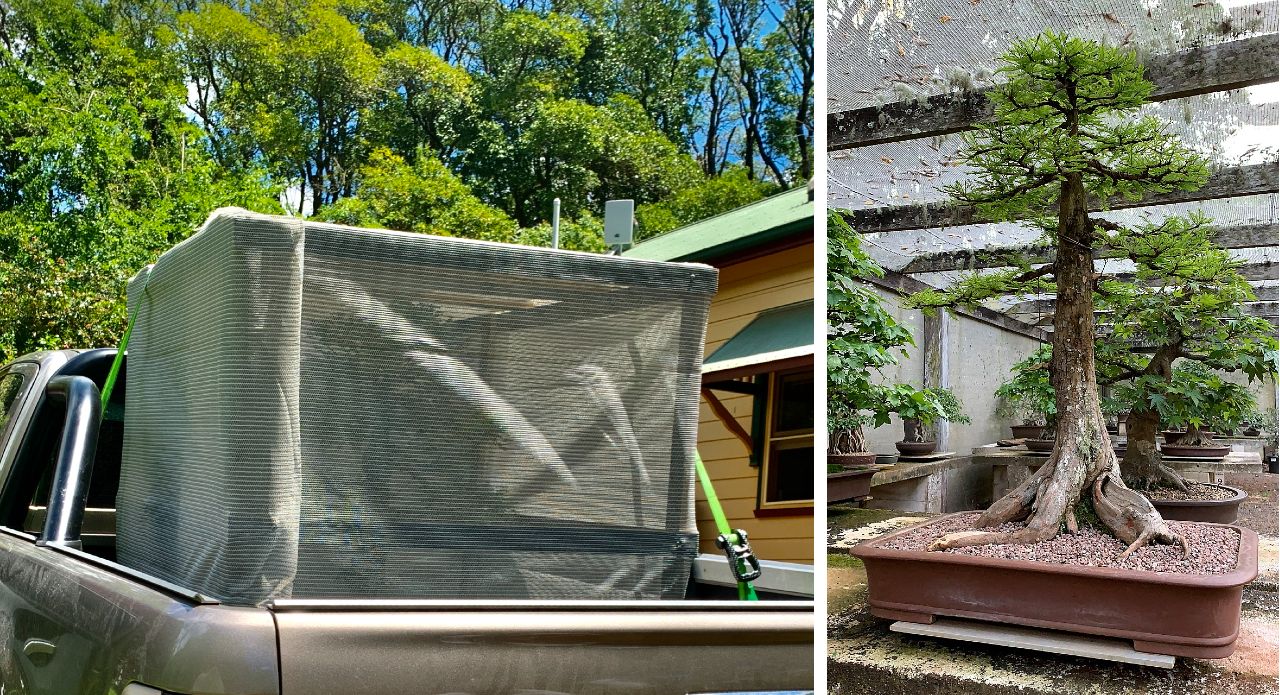
Sad to see this old bonsai go.  We have developed this bonsai from a tiny seedling/tube-stock purchased in 1981.

At just over 1mtr high, it presented a bit of a problem for the new owner to transport.  Thankfully, the new owner was resourceful enough to custom-build a protective enclosure for the journey to it's new home.

swamp cypress ready fro transport

The Australian Bonsai Gallery Website is now SPEECH ENABLED

Content Accessibility Guidelines (WCAG) is developed through the W3C process in cooperation with individuals and organisations around the world, with a goal of proving a single shared standard for web content accessibility that meets the needs of individuals, organisations, and governments internationally.

wcag screen reader

The Australian Bonsai Gallery is proud to announce that our website now has 'Screen Reader' content speech availabled, for all website content, that complies with the WCAG standards.

Simply highlight the text you wish to hear and click on the 'play' button on the bottom of the screen.

screen reader

History of an Old Cedrus Atlantica Bonsai

At over 110cm tall this old Atlantic cedar is a prominent feature at The Australian Bonsai Gallery.  We have been refining this old cedar for the past 12 years.  

Before the Bonsai Gallery acquired it, this bonsai had been in the care of Ian Hearn for over 30 years. 

Originally a twin trunk tree purchased by Ian from Owen Melmeth in approximately 1978 on the Central Coast.  Owen acquired the Cedar from a Returned Soldiers Home near Mt Ousley where it grew on the grounds, in a concrete pot, for many years.

In 1989 the lower branching was removed.  Ian then grew it on in an old wine barrel for a number of years before transferring back into a bonsai pot.

Ian had developed and refined this bonsai, from 1978, but soon after moving to the North Coast of NSW it was clear that it needed a more suitable environment to grow well.  That is the time, 2007,  that we were fortunate enough to have taken over as the current 'care-takers'....

....... the story continues.


atlantic cedar bonsai history 

old atlantic cedar 2007 1984 bonsai gallery 

Old Swampy Forest Clean-up

Spring cleaning this old swampy forest.  All from tube-stock I purchased in 1981.  Still growing vigerously after being on this granite slab for over 9 years.!!

I will have to 'bite-the-bullet' next spring and do a full re-pot on it. 

There is a short clip of this bonsai forest on our Video Feeds page HERE.

swamp cypress forest australian bonsai gallery

Old Swamp Cypress refinement

Spring update on this old Swamp Cypress.  Further refinement, building on efforts over the past few years, is paying off with some well refined branching on this bonsai.  After a recent re-pot this tree is powering on, and will require constant pinching throughout the growing season.  

We use a high proportion of our 'home-made' Akadama in our Swamp Cypress potting mix.  We have proven that our Akadama provides the perfect substrate for optimum growth and a great buffer to prevent Summer burn in this species.

If you are interested in adding this bonsai to your collection Contact Us.

swamp cypress 05 spring 2020 sale

Swamp Cypress on a Rock

Said we were not going to sell any more Swamp Cypress bonsai..... BUT.... this one is up for sale now.

You will hear and read that Swamp Cypress bonsai should have a tray of water under the pot to allow them to grow properly..... well this is nothing more than a myth.  We have been growing SC for over 4 decades without a single water tray.  It is all about the soil.

Our SC soil contains a very high proportion of Akadama, a little softer that the really 'Hard' stuff.  They grow vigorously all throughout the Spring and Summer and require constant attention during this period.

This one has just had it's first 'pinch-back' for the season.

See it for sale HERE.

swamp cypress 11 australian bonsai gallery

Some Worthy Natives to Bonsai

Strangely, I have not been very interested in bonsai Australian natives.  In fact I have had some criticism as to 'why not'.  In the past I have focussed on the 'traditional' bonsai styles and tree species.  Now I feel that I have missed out of developing some truly unique bonsai.

All is not lost, though.  I was fortunate enough to have collected many 'Yamadori' Ficus(right in picture) over 40 years ago; and developed, from seed/seedling the Dwarf Heath Casuarina (Allocasuarina-defungens - left in picture) and  Banksia-oblongifolia (centre).

The Banksia, pictured here, has just been moved into its first bonsai pot.  As you can see, it is still in development but should make a very good bonsai.

The casuarina has developed some interesting çorky bark' since the seed was collected in July-1984.

The old ficus was collected from a sandstone outcrop in 1981 where it had naturally stunted.

A word of warning about some Australian Natives......... Some species are very short lived so do your research before selecting trees for bonsai.  The last thing you want to happen is to spend 20 years developing a native bonsai and to have it die of old age in your lifetime. !!!

australian native bonsai 02 

Connect with Us